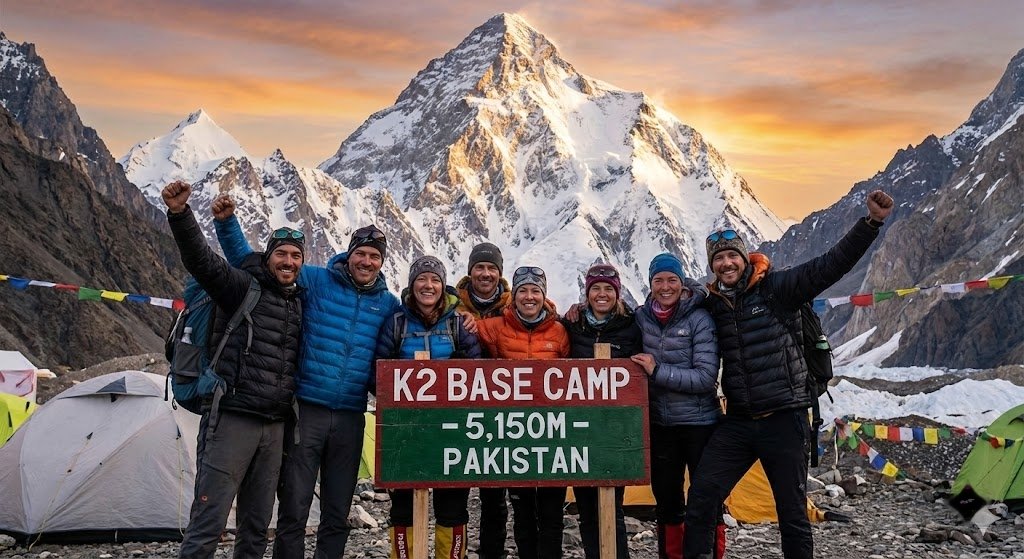
Trek to K2 Base Camp via the legendary Baltoro Glacier. 20-day premium expedition to Concordia & the world’s second-highest peak. Small groups, expert guides. Book now!
Trip Info
-
Islamabad
-
June-Aug
-
coaster/4x4/air
-
4-12
-
3-4 Star Hotels & Luxury Expedition Tents
-
Challenging / Strenuous
-
Full Board
-
4500m
Stand at the foot of the world’s most savage mountain. This 20-day expedition takes you deep into the heart of the Karakoram, trekking the legendary Baltoro Glacier to reach Concordia—the “Throne Room of the Mountain Gods”—where four 8,000-meter giants converge in a spectacle unmatched anywhere on Earth. From the ancient Balti villages of Askole to the frozen amphitheater of K2 Base Camp at 5,150 meters, every step reveals why mountaineers have been drawn to this corridor of ice and granite for over a century. This is not just a trek; it’s a pilgrimage to the most dramatic mountain landscape on the planet.
Highlights
- Trek to K2 Base Camp (5,150m) and Broad Peak Base Camp
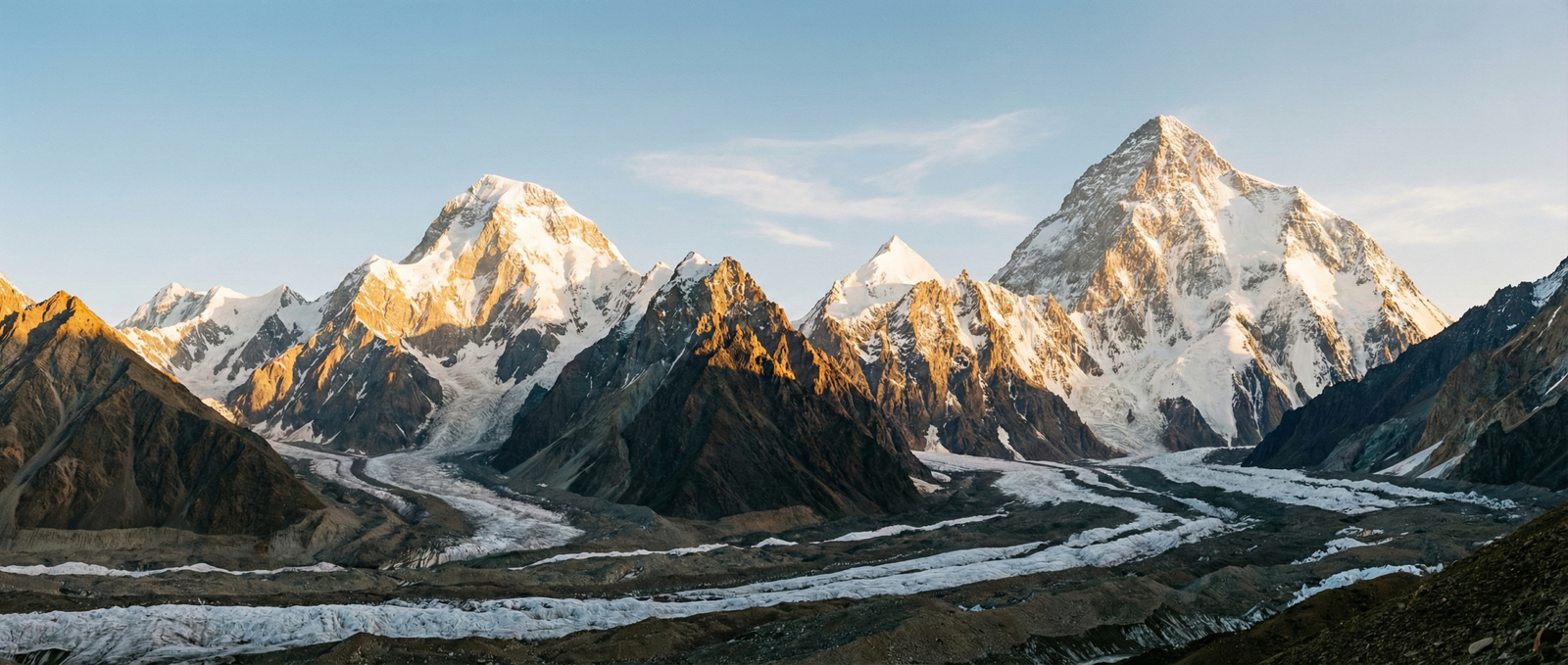
- Camp at Concordia, surrounded by K2, Broad Peak, Gasherbrum I, II & IV
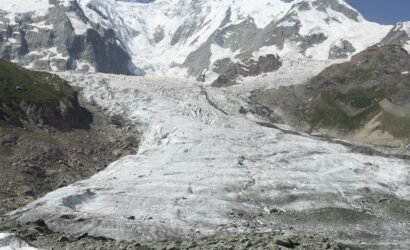
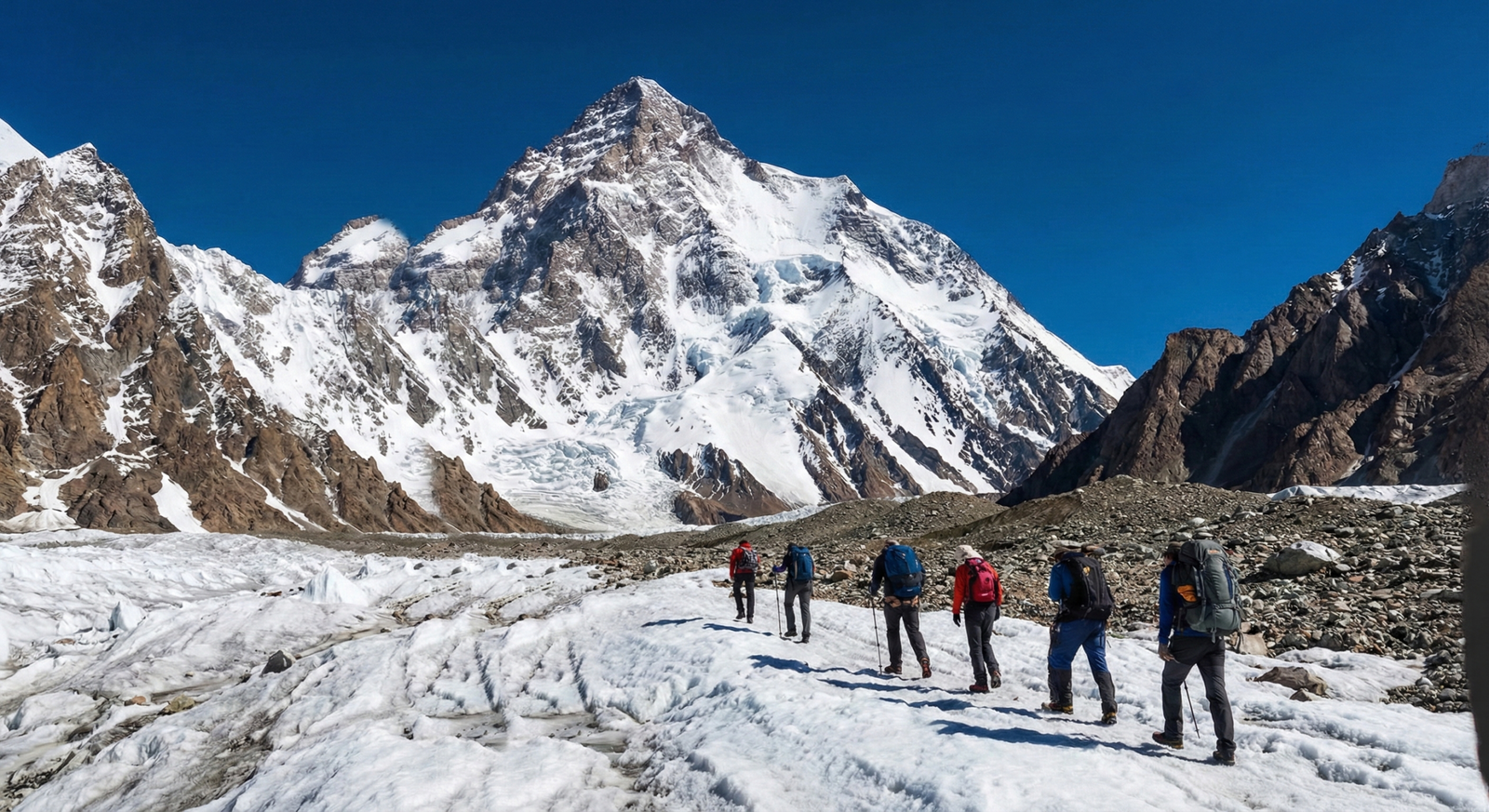
- Walk the mighty Baltoro Glacier, one of the longest outside polar regions
- Witness the Trango Towers, Cathedral Spires, and Masherbrum up close
- Experience authentic Balti hospitality in remote mountain villages
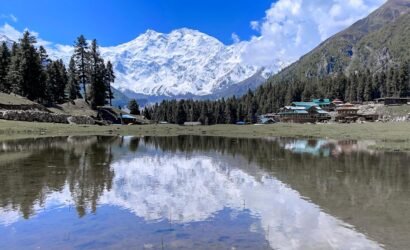
- Scenic flight over Nanga Parbat and the Karakoram Range
- Explore Skardu's ancient fort, bazaars, and Shigar Valley
Arrive at Islamabad International Airport where your NorthNomads representative greets you with a traditional welcome. Private transfer to our guest house.
Depending on your arrival time, enjoy a leisurely evening to rest and acclimatize. Pre-trek briefing with your tour leader over dinner at the guest house.
Catch the early morning PIA flight to Skardu—one of the world’s most spectacular commercial flights, soaring past Nanga Parbat (8,126m) and over the snow-capped Karakoram Range. Upon arrival in Skardu, transfer to your lakeside resort. After lunch, explore Skardu town: visit the 8th-century Kharpocho Fort perched above the Indus River, browse the vibrant bazaars for local handicrafts, and take in views of the Skardu Valley. Evening at leisure with dinner at the hotel.
Depart early for the adventurous jeep safari to Askole, the last inhabited village before the wilderness of the Baltoro. The rough road winds through the stunning Shigar Valley, passing ancient rock carvings, the 17th-century Shigar Fort, apricot orchards, and the dramatic confluence of the Shigar and Braldu rivers. Cross swaying rope bridges and navigate hairpin turns as the landscape grows increasingly remote. Arrive in Askole by late afternoon, where porters and supplies are organized for the expedition ahead. Overnight in a traditional Balti guesthouse.
The trek begins. Leave Askole and follow the Braldu River valley through a landscape of sand, rock, and scrub vegetation. The trail undulates over moraines and across seasonal streams, with views of snow-capped peaks appearing ahead. Pass through the small settlement of Korophon before reaching Jhola camp, set on a grassy riverside terrace. This first day establishes your trekking rhythm and introduces the scale of the Karakoram.
Continue along the Braldu Valley on an undulating trail with several stream crossings. The massive granite walls of Paiju Peak (6,610m) dominate the horizon as you approach camp. Paiju is a beautiful oasis with trees and grass—the last significant vegetation you’ll see until the return journey. The camp sits in a natural amphitheater with views of the Baltoro Glacier snout ahead and the towers of the Trango group beginning to reveal themselves.
A crucial acclimatization day at Paiju before tackling the glacier. Options include a hike toward the Paiju Peak viewpoint for panoramic vistas, exploring the surrounding moraines, or simply resting at camp. This is an opportunity to interact with your Balti porters and support team, learning about their mountain culture and the traditions that have sustained communities in this harsh environment for centuries. Your guides will conduct an equipment check and briefing for the glacier section ahead.
Today you step onto the Baltoro Glacier for the first time—one of the longest glaciers outside the polar regions at 63 kilometers. The initial section involves navigating the chaotic ice and moraine of the glacier’s snout. As you progress, the legendary Trango Towers emerge in all their impossible verticality—the Great Trango Tower features the world’s largest nearly vertical rock face. Camp at Khoburtse on a rocky platform beside the glacier, with the Towers looming overhead.
A shorter day allows further acclimatization. Trek along the lateral moraine of the Baltoro with constantly improving views of the Cathedral Spires, Uli Biaho, and Trango group. Urdukas (“Fallen Rocks” in Balti) is one of the most scenic campsites in the Karakoram—a green terrace perched above the glacier with sweeping views of Masherbrum (7,821m), the Baltoro ice river, and countless unnamed granite spires. Afternoon free for photography or short explorations.
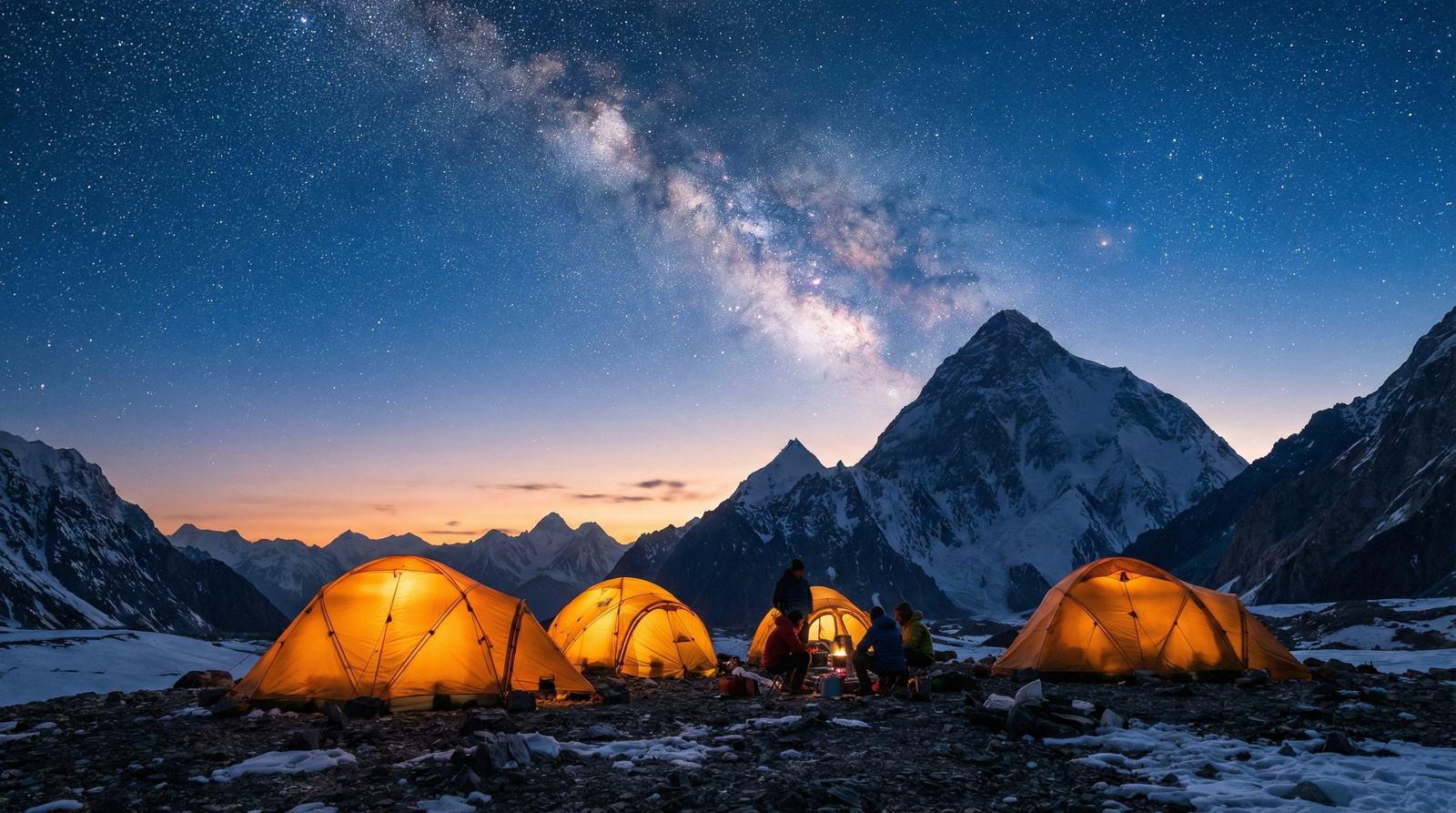
Leave the last vegetation behind and enter a world of pure ice, rock, and sky. The trail traverses the glacier itself, navigating between ice pinnacles and crevasses with your experienced guides. Gasherbrum IV (7,925m) reveals its dramatic pyramid ahead, while Masherbrum dominates the view behind. Camp at Goro II is directly on the glacier—a surreal experience sleeping on ancient ice surrounded by some of Earth’s highest peaks.
The anticipation builds with every step as you approach one of the world’s most legendary locations. Concordia is where the Baltoro meets the Godwin-Austen Glacier, creating a natural amphitheater surrounded by four 8,000-meter peaks: K2 (8,611m), Broad Peak (8,051m), Gasherbrum I (8,080m), and Gasherbrum II (8,034m). Arrive at camp and witness sunset paint the summit pyramid of K2 in golden alpenglow—a moment that defines a lifetime of adventure.
The culmination of the expedition. Depart early from Concordia and trek up the Godwin-Austen Glacier toward the south face of K2. The mountain grows impossibly large as you approach, its sheer walls and hanging seracs becoming ever more intimidating. Reach K2 Base Camp at 5,150 meters and stand where legendary mountaineers have launched their attempts on the world’s second-highest and most dangerous peak. Continue to Broad Peak Base Camp before returning to Concordia, having touched the heart of the Karakoram.
Begin the return journey with a final morning at Concordia—time for sunrise photography and a last look at the K2 massif. The descent retraces your route down the Baltoro, though the perspective reveals new angles on familiar peaks. The going is easier now, with altitude in your favor and the satisfaction of achievement in your stride. Camp again at Goro II with the Gasherbrums as your backdrop.
Continue descending the Baltoro with Masherbrum now directly ahead. The return journey offers different light and fresh perspectives on the granite towers and ice formations. Arrive at the green oasis of Urdukas and appreciate the first grass and wildflowers seen in days. Celebrate with your team as the technical glacier section is now behind you.
A longer day covering the stretch through Khoburtse and off the glacier. The Trango Towers provide a dramatic farewell as you leave the ice behind and return to the moraine trails. Paiju’s trees and relatively lush surroundings feel like a return to civilization after days in the high alpine zone. Evening celebration with your porter team.
Trek back through the Braldu Valley with the satisfaction of a successful expedition. The trail feels familiar now, and the pace is relaxed. Arrive at Jhola camp by early afternoon with time to rest, wash clothes in the river, and reflect on the journey.
The final trekking day returns you to Askole, completing the Baltoro circuit. The village feels remarkably developed after two weeks in the wilderness. Say farewell to most of your porter team, whose strength and skill made the expedition possible. Overnight in a local guesthouse with the luxury of solid walls and a roof.
Jeep journey back through Shigar Valley to Skardu. The rough road feels less daunting after the challenges of the glacier, and you’ll appreciate the dramatic scenery with new eyes. Arrive in Skardu by late afternoon. Check into your lakeside hotel and enjoy the first hot shower in over two weeks. Celebratory dinner at the hotel.
Weather permitting, fly back to Islamabad on the morning flight with spectacular aerial views of the Karakoram. If flights are cancelled due to weather (common occurrence), travel overland via the legendary Karakoram Highway—one of the world’s most dramatic road journeys. The KKH route passes through Chilas and along the Indus River, with views of Nanga Parbat. Arrive Islamabad late evening.
Reserved for weather or road delays—essential flexibility given the unpredictable nature of Skardu flights. If not needed for travel, enjoy a free day in Islamabad: visit the stunning Faisal Mosque, drive to Daman-e-Koh viewpoint in the Margalla Hills, explore the Pakistan Monument, or shop for souvenirs at the local markets. Farewell dinner with your expedition team.
Complimentary half-day city tour including Faisal Mosque, Daman-e-Koh viewpoint, and Pakistan Monument. Contact us for details.
Transfer to Islamabad International Airport for your onward flight. End of the NorthNomads K2 Base Camp Experience.
Included/Excluded
Cost Includes
- Airport transfers in Islamabad
- All domestic transportation (flights Islamabad-Skardu-Islamabad, jeep transfers)
- 13 nights luxury expedition camping with quality dome tents and air mattresses
- All meals as indicated (Full board during trek)
- Experienced English-speaking expedition leader and local Balti guides
- Porter support (20kg personal baggage allowance)
- All camping equipment (tents, dining tent, toilet tent, kitchen equipment)
- CKNP (Central Karakoram National Park) fees and permits
- Gilgit-Baltistan entry permits
- Emergency satellite phone and first aid kit
- Waste management and environmental fees
- Welcome dinner and farewell dinner
Cost Excludes
- International flights to/from Islamabad
- Pakistan visa fees
- Travel insurance (mandatory—must cover emergency evacuation to 6,000m)
- Personal trekking gear and equipment
- Meals in Islamabad except welcome/farewell dinners
- Soft drinks, bottled water in hotels, alcoholic beverages
- Personal expenses (laundry, phone calls, souvenirs)
- Tips for guides and porters (budge $150-200 recommended)
- Optional activities and excursions
- Costs arising from flight cancellations, weather delays, or itinerary changes beyond our control
Join Our Fixed Trip Starting Date
Prefer to travel on your own schedule with your own group? We offer fully customised private departures for all our treks — same expert guides, same premium inclusions, your dates. Whether you're planning a family adventure, a corporate retreat, or a solo expedition, we'll build your itinerary around you. Private groups enjoy dedicated logistics support, flexible pacing, and personalised service from Islamabad to base camp and back. Fill in the form below and our team will get back to you within 24 hours with a tailored quote.
-
Guaranteed Group Discount Available Available PackagesSaturdayJune 13, 2026ThursdayJuly 2, 2026$2,69512Available
-
Guaranteed Group Discount Available Available PackagesSaturdayJuly 11, 2026ThursdayJuly 30, 2026$2,69512Available
-
Guaranteed Group Discount Available Available PackagesSaturdayAugust 8, 2026ThursdayAugust 27, 2026$2,69512Available
FAQs
This is a challenging high-altitude trek requiring excellent physical fitness. Participants should be comfortable walking 6-8 hours daily over rough terrain at altitude. Prior high-altitude trekking experience (above 4,000m) is strongly recommended.
The best season for most northern areas is April to October. Peak season (June–August) offers the warmest weather and clearest mountain views. Spring (April–May) brings apricot and cherry blossoms. Autumn (September–October) offers stunning foliage colours with fewer crowds.
Yes, the northern regions of Pakistan—including Gilgit-Baltistan and Khyber Pakhtunkhwa—are considered safe for tourists. The local communities are renowned for their hospitality. We monitor conditions continuously and maintain contact with local authorities to ensure your safety.
Most nationalities require a visa. Pakistan offers an e-Visa facility for citizens of many countries. We recommend applying at least 4–6 weeks before your trip. Visit Pakistan’s official visa portal or contact us for guidance.
Accommodation ranges from comfortable hotels in cities to cozy guest houses in remote areas. All properties are selected for cleanliness, safety, and authentic local character. Hot water and electricity may be limited in some mountain locations.
Some areas on this itinerary exceed 4,000m. We design our itineraries with gradual altitude gain to aid acclimatisation. We recommend consulting your doctor before travel and staying well-hydrated. Our guides carry emergency oxygen and are trained in altitude sickness recognition.
Mobile coverage (primarily Jazz and Zong networks) is available in major towns but limited or absent in remote valleys. Wi-Fi is available at most hotels in larger towns but may be slow or intermittent. We recommend informing family of limited connectivity periods.
We provide a detailed packing list upon booking. Essentials include layers for variable weather, sturdy walking shoes, sunscreen, sunglasses, a hat, personal medications, and a good camera. Dress modestly out of respect for local culture—especially for women, covering shoulders and knees.
30+ days before departure: Full refund minus administrative fee
15–29 days before departure: 50% refund
7–14 days before departure: 25% refund Less than
7 days: No refund We recommend purchasing travel insurance that covers trip cancellation.
While we make every effort to follow the planned itinerary, mountain travel can be affected by weather, road conditions, or other unforeseen circumstances. We reserve the right to modify the itinerary for safety or operational reasons, always prioritising your experience and wellbeing.
Our groups range from 4 to 12 travellers to ensure a quality experience. Private departures can be arranged for families or groups preferring exclusive arrangements.
Yes, comprehensive travel insurance is mandatory for all participants. Your policy must cover emergency evacuation, high-altitude travel, and trip cancellation. Proof of insurance is required before departure.
PASSPORT & VISA
Passport valid for 6+ months with 2 blank pages –
Free e-visa for 126 countries (7-10 business days processing)
Bring spare batteries (cold drains quickly)
Ask permission before photographing people