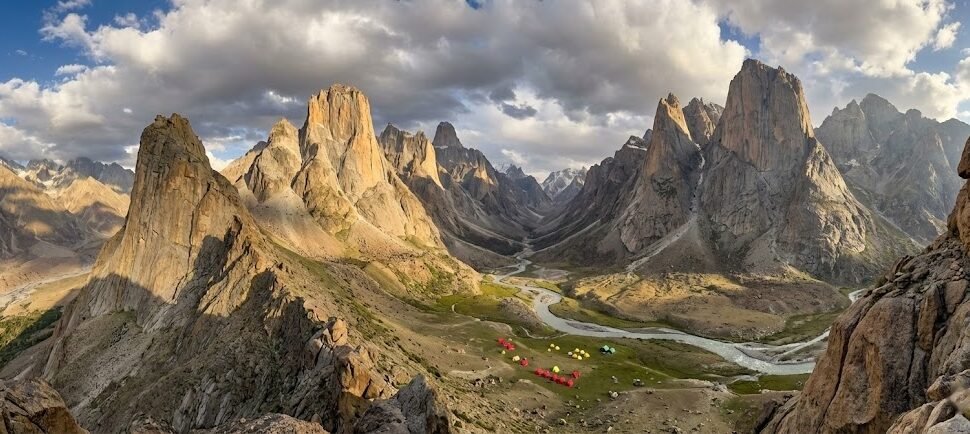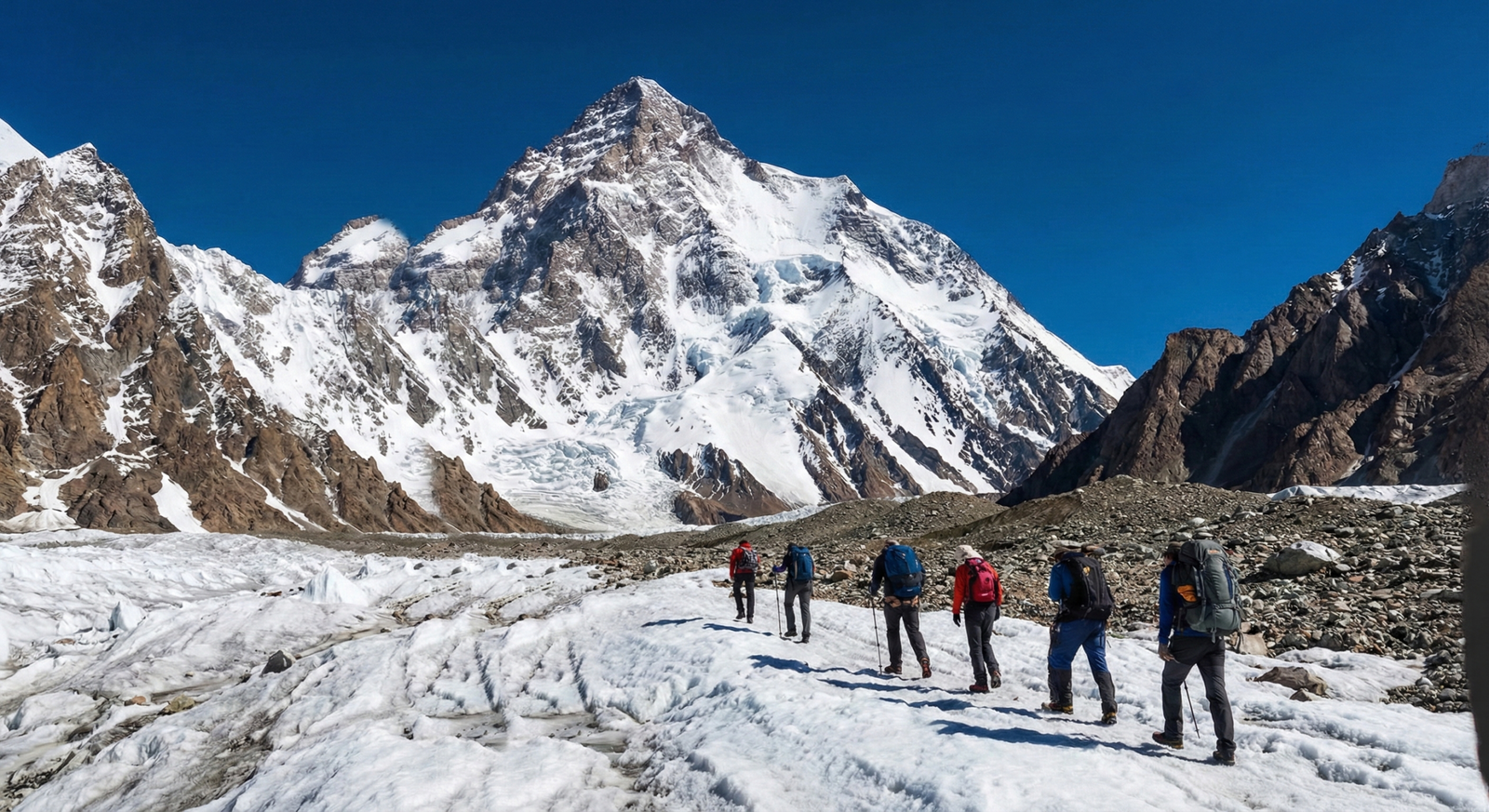
The K2 Base Camp trek is widely regarded as one of the greatest high altitude trekking experiences on Earth. Cutting through the heart of the Karakoram Range in Gilgit Baltistan, Pakistan, this expedition takes you along the legendary Baltoro Glacier to Concordia, the so-called “Throne Room of the Mountain Gods,” where four of the world’s fourteen 8,000 metre peaks are visible in a single panorama.
Unlike the crowded trails of Nepal, the K2 Base Camp trek in Pakistan remains raw, remote, and largely untouched by mass tourism. There are no teahouses. No Wi-Fi stops. No helicopter shortcuts. This is expedition-style trekking at its purest: porters, camps, and some of the most dramatic mountain scenery anywhere on the planet.
This guide covers everything you need to plan your K2 Base Camp trek: the full day-by-day itinerary, realistic difficulty assessment, costs, permits, best season, packing essentials, and practical tips drawn from firsthand experience on the route.
Table of Contents
What Is the K2 Base Camp Trek?
The K2 Base Camp trek is a 20-day guided expedition that follows the Baltoro Glacier from Askole Village in Shigar District, Gilgit Baltistan, to K2 Base Camp at 5,150 metres above sea level. The round-trip trekking distance is approximately 140 kilometres, with the trail passing through some of the most concentrated high-altitude mountain scenery in the world.
The route passes beneath Trango Towers (6,286m), Masherbrum (7,821m), Gasherbrum IV (7,925m), and Broad Peak (8,051m) before reaching Concordia (4,600m), the massive glacial junction where the Baltoro and Godwin-Austen glaciers meet. From Concordia, the trail continues north along the Godwin-Austen Glacier to K2 Base Camp (5,150m) at the foot of the world’s second highest and arguably most formidable mountain.
K2 Base Camp Trek: Quick Facts
| Trek Duration | 20 days (Islamabad to Islamabad) |
| Trekking Days | 12 days on the trail |
| Total Distance | Approximately 140 km round trip on foot |
| Maximum Altitude | 5,150m (K2 Base Camp) |
| Starting Point | Islamabad, Pakistan |
| Trailhead | Askole Village, Shigar District, Gilgit Baltistan |
| Difficulty | Strenuous. High altitude, remote, glacier travel |
| Best Season | Mid-June to mid-August |
| Permits Required | Trekking permit from the Government of Pakistan |
| Group Size | Maximum 12 trekkers |
| Accommodation | Hotels in cities, camping on the trail |
| Meals | Full board (all meals included on trek) |
K2 Base Camp Trek: Day-by-Day Itinerary
Visual Day-by-Day breakdown
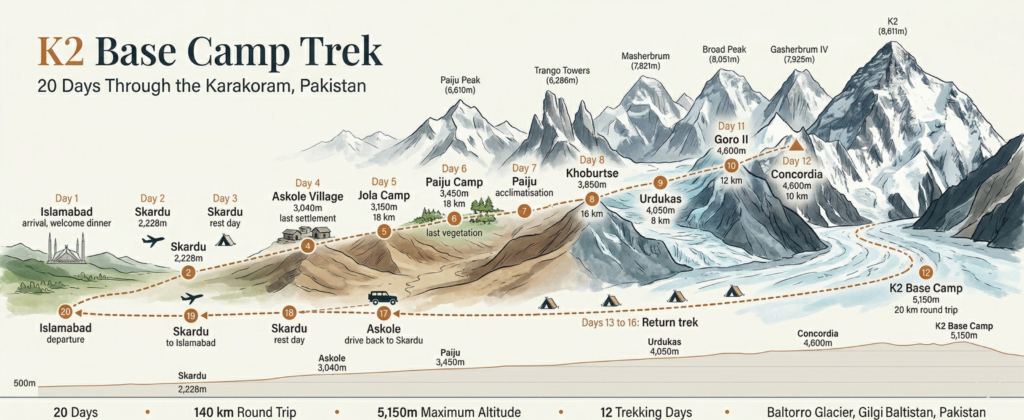
Day 1: Arrival in Islamabad, Pakistan
Arrive at Islamabad International Airport. Transfer to your hotel for rest and acclimatisation. In the evening, attend a pre-trek briefing dinner where your guide team will walk through the full expedition plan, check gear, and answer questions. Overnight in Islamabad.
Day 2: Fly Islamabad to Skardu, Gilgit Baltistan (or overland backup via Karakoram Highway)
Take the early morning PIA flight from Islamabad to Skardu, one of the most spectacular commercial flights in the world with views across the Karakoram and Nanga Parbat. Weather cancellations are common, in which case the backup plan is an overland drive via the Karakoram Highway (approximately 18 to 22 hours). Overnight in Skardu.
Day 3: Skardu, Gilgit Baltistan (acclimatisation and preparation)
A rest and preparation day in Skardu (2,228m). Visit Skardu Bazaar to pick up any last-minute supplies. Optional visit to Shangrila Resort, Upper and Lower Kachura Lakes, or Skardu Fort for acclimatisation walks. The team finalises porter logistics and equipment checks. Overnight in Skardu.
Day 4: Skardu to Askole Village, Shigar District (7 to 8 hour drive)
Drive from Skardu along the Shigar and Braldu river valleys to Askole (3,040m), the last permanent settlement before the wilderness. The road is rough and unpaved beyond Shigar town. Askole is where your porter team assembles and the trek officially begins. Overnight camping in Askole.
Day 5: Askole to Jola Camp (18 km, 6 to 7 hours trekking)
The first trekking day follows the Braldu River valley through arid, rocky terrain. The trail is relatively flat with minor elevation changes. Cross a suspension bridge and arrive at Jola Camp (3,150m) beside the river. Overnight camping.
Day 6: Jola to Paiju Camp (18 km, 6 to 7 hours trekking)
Continue along the Braldu River with increasingly dramatic views of the Karakoram peaks ahead. The trail passes through a beautiful grove of juniper and willow trees before reaching Paiju Camp (3,450m), positioned at the snout of the Baltoro Glacier. Overnight camping.
Day 7: Rest Day at Paiju Camp (acclimatisation)
A mandatory rest day for acclimatisation before stepping onto the glacier. Paiju is your last camp with natural greenery. Take short acclimatisation walks, enjoy views of Paiju Peak (6,610m), and prepare for glacier travel. Overnight camping at Paiju.
Day 8: Paiju to Khoburtse (16 km, 7 to 8 hours trekking)
Step onto the Baltoro Glacier for the first time. The terrain changes dramatically: loose moraine, ice, and boulders. Navigation requires careful footing. Pass Liligo Camp and reach Khoburtse (3,850m) on a grassy shelf above the glacier with views of the Trango Towers. Overnight camping.
Day 9: Khoburtse to Urdukas (8 km, 5 to 6 hours trekking)
A shorter but rewarding day. Trek along the lateral moraine of the Baltoro Glacier to Urdukas (4,050m), one of the most scenic camps on the entire route. The Trango Towers (6,286m), Cathedral Spires, and Uli Biaho (6,417m) dominate the skyline. Overnight camping.
Day 10: Urdukas to Goro II (12 km, 6 to 7 hours trekking)
Cross onto the surface of the Baltoro Glacier itself. The walking surface becomes ice and rubble. Views open up to Masherbrum (7,821m), one of the most beautiful peaks in the Karakoram. Arrive at Goro II (4,300m) on the glacier. Overnight camping.
Day 11: Goro II to Concordia (10 km, 5 to 6 hours trekking)
This is the day that defines the K2 Base Camp trek. Arrive at Concordia (4,600m), the junction of the Baltoro and Godwin-Austen glaciers. The panorama is staggering: K2 (8,611m), Broad Peak (8,051m), Gasherbrum IV (7,925m), Gasherbrum I (8,080m), Mitre Peak (6,010m), and Chogolisa (7,665m) are all visible. Overnight camping at Concordia.
Day 12: Concordia to K2 Base Camp and return to Concordia (20 km round trip, 8 to 10 hours trekking)
The summit day of the trek. Head north along the Godwin-Austen Glacier to K2 Base Camp (5,150m) at the foot of the world’s second highest mountain. Spend time at base camp taking in the sheer scale of K2’s south face before retracing your steps back to Concordia. This is a long, demanding day at high altitude. Overnight camping at Concordia.
Days 13 to 16: Return trek from Concordia to Askole (4 trekking days)
Retrace the route back down the Baltoro Glacier over four days: Concordia to Goro II, Goro II to Khoburtse, Khoburtse to Paiju, and Paiju to Askole. The return is faster with the benefit of acclimatisation and generally favourable downhill gradient, though glacier crossings remain demanding. Camp each night at the same sites used on the approach.
Day 17: Askole to Skardu (7 to 8 hour drive)
Drive back along the Braldu and Shigar valleys to Skardu. A hot shower and a real bed await. Celebratory dinner in Skardu. Overnight in hotel.
Day 18: Skardu (rest day)
Buffer day in Skardu for rest and recovery. Serves as a weather contingency for the return flight. Optional exploration of Skardu Fort, Kachura Lakes, or the local bazaar. Overnight in hotel.
Day 19: Fly Skardu to Islamabad (or overland backup)
Return flight to Islamabad. If weather cancels the flight, begin the overland drive via the Karakoram Highway. Overnight in Islamabad.
Day 20: Departure from Islamabad
Transfer to Islamabad International Airport for your onward flight. Optional extra night in Islamabad with a complimentary half-day city tour covering Faisal Mosque, Daman-e-Koh viewpoint in the Margalla Hills, and the Pakistan Monument.
How Difficult Is the K2 Base Camp Trek?
The K2 Base Camp trek is classified as strenuous and is one of the most challenging non-technical treks in the world. There are no technical climbing skills required, but the physical demands are significant.
Key difficulty factors include:
- Altitude: The maximum elevation is 5,150m at K2 Base Camp. Most trekking days are spent above 3,500m, and the Concordia to K2 BC push involves a full day above 4,600m.
- Glacier travel: Six to seven days of the trek are spent walking on the Baltoro Glacier, which involves navigating loose moraine, ice, and boulders. Ankle injuries are the most common issue.
- Duration: Twelve consecutive days of trekking with only one rest day at Paiju. Daily distances range from 8 to 20 kilometres.
- Remoteness: There is no helicopter evacuation readily available on the Baltoro. The nearest medical facility is in Skardu, multiple days away by foot from the upper glacier.
- Weather: Conditions can change rapidly. Snow, rain, and strong winds are possible at any time during the trekking season, even in July.
Recommended preparation: Start a structured fitness programme at least three to four months before departure. Focus on cardiovascular endurance (hiking with a loaded pack, stair climbing, running), leg strength, and core stability. Previous experience trekking above 4,000m is strongly recommended.
What Is the Best Time to Trek to K2 Base Camp?
The K2 Base Camp trekking season runs from mid-June to mid-August, with July being the optimal month. Before mid-June, river crossings near Askole may be impassable and snow cover on the upper Baltoro makes progress slow and dangerous. After mid-August, temperatures drop sharply, the days shorten, and early winter storms become a serious risk.
July offers the best combination of stable weather, manageable river levels, longer daylight hours, and the presence of mountaineering expeditions at base camp (which adds to the atmosphere and provides a safety buffer on the upper glacier).
How Much Does the K2 Base Camp Trek Cost?
The cost of the K2 Base Camp trek varies depending on group size and the level of service included. Our fully inclusive, guided 20-day expedition departs from Islamabad with all logistics handled directly by our own ground team in Gilgit Baltistan. There is no subcontracting to third party operators. That is why our expeditions are rated 5/5 on TripAdvisor.
2026 Season Pricing (per person, USD):
| Group Size | Price Per Person |
|---|---|
| Solo trekker (1 person) | $2,695 |
| 2 persons | $2,495 |
| 3 to 4 persons | $2,295 |
| 5 to 6 persons | $2,095 |
| 7 to 12 persons | $1,895 |
What is included: All accommodation (hotels in Islamabad and Skardu, full camping on the trail), all meals during the trek, an experienced English-speaking guide, a full Balti porter team, all camping and mess tent equipment, government trekking permits and park fees, internal flights (Islamabad to Skardu return), and all ground transport throughout the expedition.
What is not included: International flights to Pakistan, travel insurance (mandatory for all participants), personal trekking gear and clothing, tips for guides and porters, visa fees, and any personal expenses in cities.
What Permits Do You Need for the K2 Base Camp Trek?
All foreign trekkers require a trekking permit issued by the Government of Pakistan through the relevant tourism authority. Your trekking operator handles the full permit application and approval process. You will also need a valid passport with at least six months of validity and a Pakistan visa (most nationalities can obtain an e-visa or visa on arrival).
If your itinerary includes any restricted zones, a No Objection Certificate (NOC) may also be required. Your operator will advise on this and manage the paperwork.
What to Pack for the K2 Base Camp Trek
Your operator will provide a full packing list, but the essentials include:
- Four-season sleeping bag rated to at least -15°C
- Insulated sleeping mat (R-value 5+)
- Layered clothing system: moisture-wicking base layers, insulating mid layers, waterproof and windproof outer shell
- Sturdy, broken-in trekking boots with ankle support (stiff soles recommended for glacier moraine)
- Gaiters (essential for glacier travel and scree)
- Trekking poles (highly recommended for glacier stability)
- Sun protection: SPF 50+ sunscreen, UV-blocking sunglasses or glacier goggles, wide-brim hat
- Personal first aid kit with blister treatment, painkillers, altitude sickness medication (consult your doctor about Diamox)
- Headtorch with spare batteries
- Reusable water bottles (minimum 2 litres capacity) with purification tablets
- Dry bags or waterproof stuff sacks for protecting electronics and clothing
Weight limit for porter-carried bags is typically 20 to 25 kg per trekker. You carry a daypack (5 to 8 kg) with water, snacks, camera, sun protection, and a warm layer.
Upcoming K2 Base Camp Trek schedule
Frequently Asked Questions: K2 Base Camp Trek
Do I need climbing experience for the K2 Base Camp trek?
No technical climbing is required. The K2 Base Camp trek is a high-altitude trekking expedition, not a mountaineering ascent. However, strong fitness and ideally previous trekking experience above 4,000m are essential.
Is the K2 Base Camp trek safe?
With a reputable, experienced operator and proper preparation, the K2 Base Camp trek is a manageable expedition. The main risks are altitude sickness, weather changes, and glacier terrain. Having a guide team with direct ground operations (not subcontracted to third parties) and robust safety protocols significantly reduces these risks.
Can I do the K2 Base Camp trek solo?
Independent trekking on the Baltoro Glacier without a guide team and porters is not practical or recommended. The route requires a government-issued trekking permit obtained through a licensed operator, and the logistical demands (food, fuel, camping equipment, and navigation) require a support team.
Is there phone signal on the K2 Base Camp trek?
There is limited mobile coverage in Skardu and occasionally in Askole. Once on the Baltoro Glacier, there is no mobile phone signal. Some operators carry satellite communication devices for emergencies.
How does the K2 Base Camp trek compare to Everest Base Camp?
The K2 Base Camp trek is longer, more remote, more physically demanding, and far less crowded than the Everest Base Camp trek in Nepal. There are no teahouses or lodges on the Baltoro; it is fully tent-based. The maximum altitude (5,150m) is similar to Everest Base Camp (5,364m), but the glacier travel and route length make K2 significantly more challenging overall. For experienced trekkers seeking a more rugged and authentic mountain experience, K2 is the superior choice.